
This is the place to start if you are new to this and seeking useful information on Cardano, guidance on how to choose a stake pool, set up your wallet, and delegate to a pool. Links to explore:
- The Essential Cardano page has wealth of information and links and provides a great onboarding guide.
- We also recommend r/cardano and the Cardano Foundation Forums where you will have access to advice and guidance, and an opportunity to engage with the community.
- This first whiteboard session from Charles Hoskinson explains how Cardano builds and improves on the 1st and 2nd generation projects such as Bitcoin and Ethereum.
Why Cardano?
Cardano takes the best aspects of Bitcoin (UTxO, Decentralisation, Strong Security Guarantees) and Ethereum (Smart Contracts), bringing them together with a highly energy efficient proof of stake design.
These technical choices combined with a decentralised approach and open source philosophy increases confidence in long term success and wide adoption. Some of the major competitive differentiators include:
- A scientific and mathematical basis to the design with academic peer review
- The Proof of Stake protocol Ouroboros (with no lock-in or slashing) uses game theory to guarantee a minimum level of decentralisation and is environmentally sound
- The Plutus Smart contract language supports formal verification (based on Lambda calculus) and is made widely accessible through high level compilers such as Aiken
- Interoperability via side chains and bridges helps Cardano act as an inter-network of blockchains, with Layer 2 isomorphic scaling technology such as Hydra heads permitting high transaction throughputs
- Transparent and scalable governance mechanisms facilitate ongoing development and innovation
The Cardano community is diverse, focused on positive outcomes, and willingly share knowledge. The leadership and vision from the founding entities is strong. This will nurture the decentralised ecosystem to the point where it is fully s
What is Cardano?
Cardano is a Proof of Stake (PoS) blockchain network, providing a decentralized application (dApp) platform with a multi-asset ledger and verifiable smart contracts. Built with high-assurance formal development methods, Cardano has the scalability, interoperability, and sustainability needed for real-world applications with a small environmental footprint.
Based on peer-reviewed academic research, Cardano has an ethos of openness and transparency. All of the research and technical specifications that underpin Cardano are publicly published. The network is fully decentralized, and belongs to the community. From Q4 2024 the community has decided its future through the built in governance features.
There are 3 founding entities for the ecosystem:
- Cardano Foundation (CF), responsible for working with institutions, businesses, regulators, and policymakers. They run the annual summits.
- Input Output Group (IOG), responsible for development activities under contract from CF.
- Emurgo, responsible for commercialisation and industry development.
What’s the roadmap?
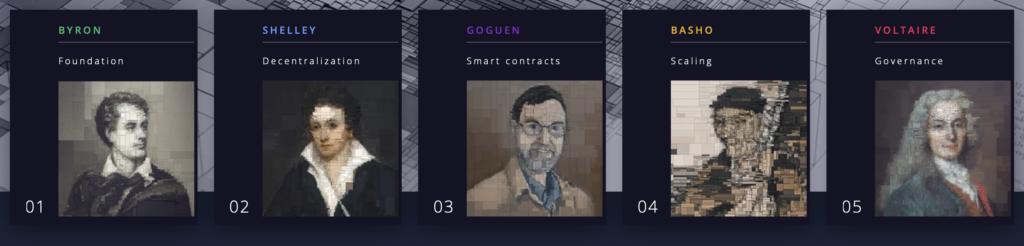
There were 5 work streams to the project delivered in overlapping phases:
- Byron- foundations (Complete)
- Shelley- staking and stake pools, technical decentralisation (Complete)
- Goguen- smart contracts and native assets (Complete)
- Basho- scaling via Mithril, Hydra L2, and Leios (Ongoing)
- Voltaire- governance decentralisation (Complete)
Full details of the roadmap are available, there has been significant progress through 2020-2025.
What is a Cardano Stake Pool?

A stake pool is a reliable node on the Cardano network that processes transactions and add blocks to the chain recording these transactions.
The protocol used requires a reasonable number of stake pools to be online at any time, and uses verifiably random function (VRF) to select a leader for each slot that will forge a block.
More stake increases the chance of a pool being selected as slot leader, and each time the pool successfully forges a block it receives a reward which is shared proportionately with delegators.
Stake pool operators (SPO’s) need to have the skills to ensure secure operation. They specify a margin for providing the service and deduct their running costs from any rewards.
How do I choose a stake pool?
The best place to start is on PoolTool.io, or Cardanoscan.io. They allow pools to be ranked based on a number of characteristics:
- Live and Active Stake- shows ₳ staked this epoch and the next
- Saturation level- once the pool is bigger than ~77mn ₳ rewards for delegators start to decline
- Block production history- shows if the pool is reliable
- Pledge- how much ₳ pool operators have committed to the pool
- Delegators- how many people are delegating to the pool
- Fixed and variable costs- how much does the stake pool charge for its services
- Historical returns for delegators
We recommend starting with pools that have a reasonable track record forging blocks. We also suggest restricting your selection to pools with a reasonable pledge amount, which demonstrates commitment and acts against excessive centralisation.
What wallets can I use?
The original wallet for Cardano which supports staking is:
- Daedalus– an open source full node wallet supported by IOG. Available for download here, Daedalus has a really intuitive user interface, and runs on Mac, Linux and Windows.
We recommend using Daedalus for secure storage of higher value wallets, or where you have specific needs as it takes a high spec machine and significant time to sync. There are now many lightweight browser based alternatives which work with dApps. A few options include:
- Lace: A very intuitive IOG maintained wallet that supports Chrome, Brave, Edge and Firefox via a plug-in browser extension.
- Eternl: A community developed wallet which has comprehensive features and supports Chrome based browsers.
- Vespr: A newer addition to the stable, very intuitive and attactive UI design, works well on iOS.
How do I delegate?
Delegation is intuitive in most wallets and details can be found from the wallet provider.
Where can I buy?
We recommend Kraken because they have fair charges, deep liquidity in most traded cryptocurrencies, and a wide range of traded pairs.
They have good in country presence as well which matters when you are transferring to or from fiat currencies.
We do not recommend that you keep deposits on exchanges any longer than necessary to trade. Once you’ve traded move them back to a secure wallet that you control. Kraken have reasonable deposit and withdrawal limits, especially once KYC checks have completed.
You can also buy ADA directly in many wallets.